
By Elodie Reed
Communications Manager, UVM Extension College of Agriculture and Life Sciences
Nestled in some gentle hills in Cornwall, Vermont, there is a continuous, nearly-mile-long, several-horse-length-wide track.
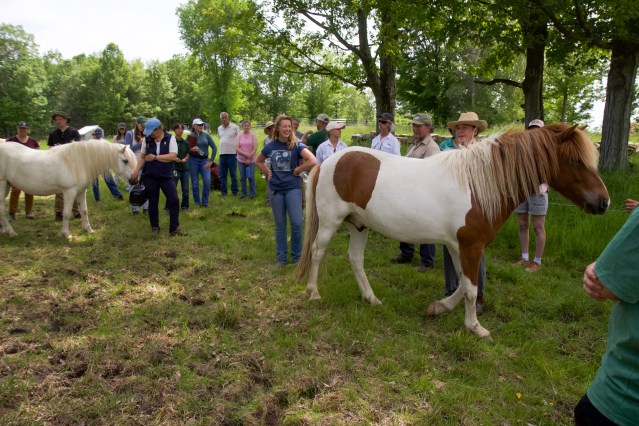
Down its path, several Icelandic horses nibble, socialize and walk when they feel like it to the barn, where there’s constant access to hay bags, shade and water. All around them, on the inside and the outside of the track, is lush green grass.
Welcome to Paddock Paradise.
Close to 50 attendees drove to Becky Kinkead’s barn to see this Paddock Paradise example on Thursday, June 4. The workshop, hosted by University of Vermont Extension Center for Sustainable Agriculture and the Vermont Grass Farmers Association, attracted people of all ages with varying experiences in caring for horses.
That included faculty, students, apprentices and staff from the College of Agriculture and Life Sciences’ horse barns and programs.
“In order to sustain the young stock that we have, we really need to give them green grass,” said UVM Morgan Horse Farm Equine Manager Jamie Maguire. “So we’re exploring options.”
Leading the workshop was Dr. Katherine Goldberg, a veterinarian and licensed clinical social worker at Counseling and Psychological Services at Cornell University. She also acts as a consultant on species-appropriate husbandry for horses.

“The horse world, as we all know, is full of a lot of opinion, legend,” Goldberg said. “My bias toward all of this is to really be both practical and also academically rigorous.”
On the academic side, Goldberg spoke about the telos — the essential species nature and purpose — of horses based on their anatomy, physiology, behavior and cognition.
“They’re nomadic grazers, nomadic trickle feeders,” she said. “They’re inherently very social creatures, they’re inherently, enormously, choice-based, they’re constantly thinking and thinking and thinking.”
And Goldberg emphasized how horses have only been in close proximity to humans for 5,000 of their 55-million-year evolutionary history.
“That means that horses have been doing just fine without us for 99.99% of their entire evolutionary timeline,” she said. “But by and large, horses now are not living according to their choice.”

For these reasons, Goldberg said horses need as much access as possible to the “3Fs”: Friends. Forage. Freedom. She added that freedom is not just the absence of confinement, but the ability to choose when to eat, drink, move, sleep, groom one another, fight or play.
“When the needs of the horse are met, they have a life that is [closer to] their own,” she said.
What Goldberg said she appreciates about a Paddock Paradise track system, like the one at Becky Kinkead’s farm in Cornwall, is how it provides the 3Fs.
Goldberg added, however, that she wanted to get away from the binary of “good horse keeper” and “bad horse keeper.” Instead, she said there’s a spectrum of what’s realistic for every horse keeper given the limits of time, finances and emotional investment.
“There are things you can do to move closer towards the 3Fs in any scenario that you have,” she said.
A small pasture could be set up to have horses walk around the outside edges of the space, for example.

“Right there, you’ve improved a bunch of things,” Goldberg said. “You’ve given them movement, given them some enrichment.”
Many are interested in how track systems might encourage horses to move more and decrease instances of obesity. As for what the research says about that — results are mixed.
One 2024 paper examined how much pairs of horses moved on a track compared to traditional pastures, and found that their movement didn’t noticeably change. Another study did a similar comparison for herds of ponies with seven to eleven members, and found those ponies moved more on the track system.
Goldberg noted one of the differences between the studies was the number of equids. And she pointed out that pairs of horses are not herds.
“I think that’s an interesting variable,” she said. She added, half-joking, half-not: “We need more horses!”
One study did find that a track system led to reduced vegetative biomass and more erosion, when compared to a traditional pasture.
That absence of vegetation, and even putting down pebble surfacing on a track system, can appeal to those wanting to manage their horses’ weight, plus promote their hoof health.
It might also be of interest to people who still hope to graze their horses in a separate pasture, but only when there’s more mature, fibrous grass, which is healthier for both horses and the soil.
“A track is also a tool to take pressure off your field,” said UVM Extension Grazing Specialist Amber Reed.
Extension Grazing Programming Coordinator Jascha Pick noted that people can determine when their fields are ready for grazing by looking at the leaves on the base of grass stalks.
If there are three leaves on the plant, that’s when it’s gone through enough photosynthesis to store the sugar it needs for regeneration.

“Time and height of grass has nothing to do when it’s ready to be grazed,” Pick said. “It’s all about the stage of growth.”
Becky Kinkead, who offered up her farm for last week’s workshop — and whose horses were plenty happy to nose between the many visitors in their track — received assistance setting up her Paddock Paradise system from the grazing specialists at Extension’s Center for Sustainable Agriculture.
“When we started working together, they hadn’t worked with a lot of horses,” Kinkead said. And she was struggling with overgrazing.
But then Kinkead said she and Extension staff learned side-by-side about the particular needs of horses, plus the needs of the pasture.
“It was incredibly helpful to have someone you could reach out to anytime with questions,” Kinkead said.
And the result? She said it’s visible in her horses, who are peaceful and constantly moving, and her fields, where a friend now rotationally grazes sheep and leaves behind beautiful, healthy grass.
“I’ve seen an improvement,” Kinkead said.
Learn more about the UVM Extension Center for Sustainable Agriculture on our webpage.
The post Paddock Paradise promotes food, forage and freedom for horses first appeared on Vermont Daily Chronicle.
The post Paddock Paradise promotes food, forage and freedom for horses appeared first on Vermont Daily Chronicle.