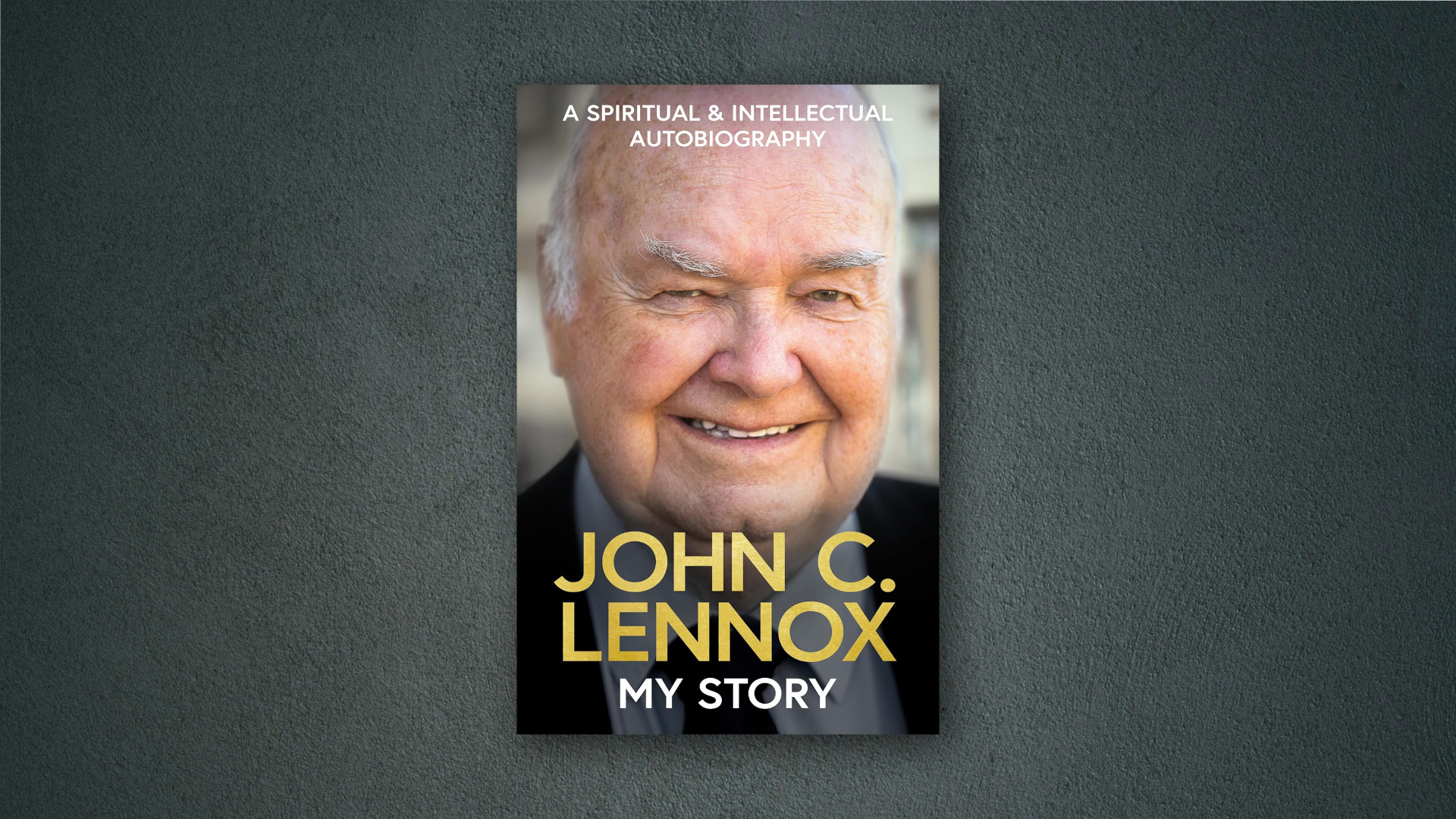
A friend once told me that he didn’t want to become a Christian because Christianity was boring. Reading John C. Lennox’s book My Story: A Spiritual and Intellectual Autobiography provides plenty of evidence that the Christian life isn’t boring. Lennox is emeritus professor of mathematics at the University of Oxford and emeritus fellow in mathematics and the philosophy of science at Green Templeton College. He’s also had an incredibly exciting life.
I first heard of Lennox when he spoke in chapel at my seminary on his way to debate Richard Dawkins. What Lennox said in that lecture nearly 20 years ago has shaped my understanding of Christianity for decades since.
His many adventures include journeying behind the Iron Curtain, speaking on university campuses around the world, and doing high-level academic work in mathematics.
This is an abbreviated and edited transcript of my interview with Lennox about his latest book. For the full interview, listen to the audio in the link above or view the video.
What were some formative aspects of your childhood that shaped your character?
The most important aspect was the environment in which I grew up.
The atmosphere in Northern Ireland when I was growing up was not very pleasant. It was quite sectarian—very partisan and bigoted. My parents were very keen Christians, but they were not sectarian.
My parents loved me enough to encourage me and show me what Christianity meant without forcing it down my throat. That was very unusual. Many of my contemporaries from Ireland lost any notion of faith in God as soon as they left home, because it had been forced on them. But my parents weren’t like that.
John Lennox’s life is proof that Christianity is anything but boring.
In particular, my father was not highly educated, but he loved Scripture. And he knew quite a lot about Scripture, and he knew enough to put me on a path of seeing that Scripture was tremendously interesting. He used it to introduce me to ancient history, to the whole history of Israel, and to thinking theologically. And he put in my way books by Christians like F. F. Bruce. I read them and loved them even as a teenager. So I grew up with the idea that Christianity was very intellectually wise and sensible.
Another thing that’s quite important is that my father didn’t only introduce me to the Christian worldview; he introduced me to other worldviews because he felt that I needed to know what other people think. And I spent my life finding out what other people think and running it past my Christian worldview. That strengthened my faith in Christ and God immeasurably.
How did you get involved in ministry behind the Iron Curtain in Eastern Europe during the Cold War?
When I was doing my doctorate in Cambridge, my research supervisor said to me that it was worth applying for a postdoctoral fellowship in Germany. And so, I went off to Germany, and I got the language deliberately. I spent a lot of time learning German that year.
Then, during the year, I met in Berlin some Hungarian Christians, and they invited me to Budapest. In that country, because of the Second World War, very few people spoke English, but some very able and gifted people spoke fluent German. So I preached in German, and they interpreted.
There was such a tremendous response in Hungary. Apparently, they’d never heard this kind of systematic exposition of an entire book of Scripture before.
In Hungary, I met people from the German Democratic Republic (GDR), which was very much more communistic than Hungary was even in the days of the Cold War. That led to invitations to go to the GDR. From 1976 to 1989, when the Berlin Wall fell, I went numerous times to Hungary, Poland, and the GDR.
As you were behind the Iron Curtain, you were in enemy territory, politically speaking. Was there ever a time that you weren’t sure you were going to make it out?
Oddly enough, people have asked me in many interviews, Was I scared? And the answer is no.
I had a great sense of peace, and importantly, that was shared by my wife and family. And I had such a sense of God directing me to those countries.
But I had peace that God would protect me, and he did. Although it’s absolutely amazing looking back at how I got away with it because I was traveling on my own. Anything could have happened without other people knowing. And that’s the incredible thing. I just am amazed as I look back that I came through as safely as I did.
What is the biggest challenge for Christians as we try to communicate the gospel to our culture? How have you seen that change over the decades?
The hardest questions to answer are the existential ones concerned with pain and suffering. They’re the hardest questions for any worldview to answer. If you haven’t got a worldview that has something to say to those in pain or suffering, you haven’t got a worldview that’s worthy of the name.
I’ve noticed over the years that the aggression of the new atheists has faded away. Questions tend to come more on issues of meaning and ethics and morality: What is a human being? What does my life mean? Can I really have a purpose?
What gives you hope for the church for the next 50 years?
When Christianity started, there were 11 people that trusted Jesus and a world that was pluralistic. There were many false gods, and the Caesars were being revered as gods. Now, in the 21st century, we’re being encouraged to develop humans into superintelligences or little gods by people like Yuval Noah Harari. So, we’re back in the New Testament world, almost.
The promise of transhumanists like Harari is that the problem of physical death will be solved as a medical problem pretty soon in this century. What gives me hope is that the problem of physical death was solved 20 centuries ago when God raised Jesus from the dead.
The central hope that Christians offered to the world in the first century was that Jesus, whom God raised from the dead, had gone to heaven, literally and physically—and I believe that as a scientist—and that he will one day return in the same way that they saw him go.
That I think is the best hope that can be offered to humanity with all its difficulties, pain, and suffering.