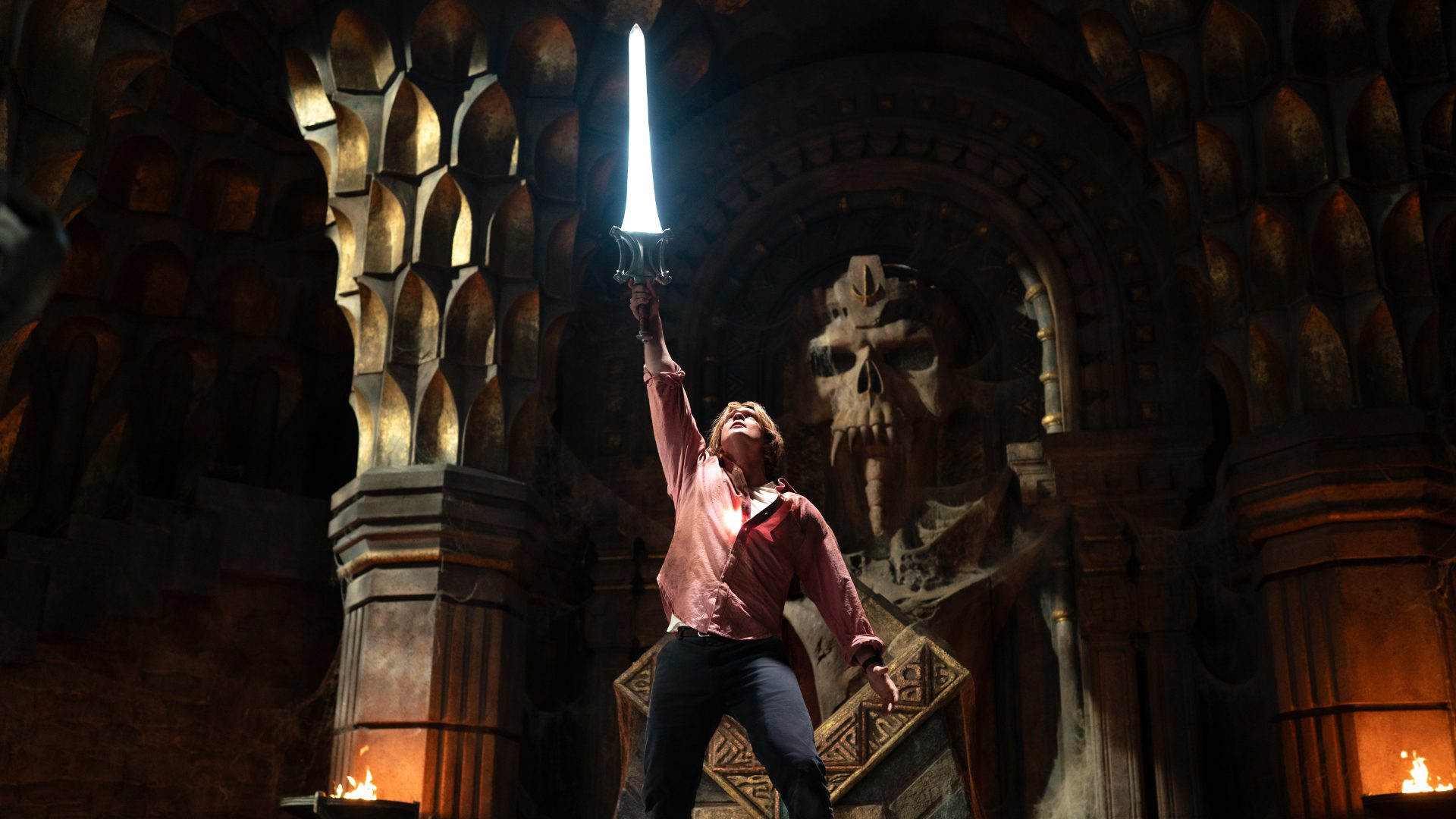
Of all the campy cartoons of the 1980s, He-Man and the Masters of the Universe may be one of the goofiest. Based on the Mattel toys, the series followed the adventures of the superpowered barbarian He-Man and his colorful cast of supporting characters—figures like She-Ra, Cringer the Green Tiger, and the iconic villain Skeletor.
Despite numerous attempts to maintain relevance, though, Masters of the Universe largely faded from prominence throughout the ’90s and ’00s. While other toy-based media franchises like Transformers found success reinventing themselves for new generations of fans, He-Man and company were left behind . . . until recently.
Today, Masters of the Universe is having a resurgence. First there was a new animated series from Netflix. And now the live-action film adaptation has been well received by audiences and even praised by many critics. It seems like the world might be ready for the return of He-Man. But why now?
The rise, fall, and return of He-Man might reveal something about our culture’s shifting mood—and how the church could respond.
Choke Hold of Irony
Along with 1980s contemporaries like G. I. Joe, Voltron, and ThunderCats, Masters of the Universe was unapologetically goofy, sincere, and escapist. Each episode of the original series ended with a character breaking the fourth wall to address the audience directly, providing a moral lesson. There was nothing cynical or complicated about He-Man.
But by the 1990s, sincerity and optimism in pop culture were replaced by irony and cynicism. Top-grossing movies from the ’80s included Top Gun, Indiana Jones, and E.T. By contrast, the ’90s gave us complex, self-referential, deconstructive stories like Forrest Gump, Pulp Fiction, and Fight Club.
The ’90s were the high point of postmodernism, a cultural mood that prioritized deconstruction and irony. There was a prevailing sense that the straightforward stories of previous decades were simplistic and even dangerous, perpetuating flattened versions of reality’s complexity or conveniently ignoring marginalized perspectives. Artists and storytellers attempted to deconstruct these prevailing narratives by challenging conventions and subverting expectations.
At its best, postmodern storytelling exposed simplistic or deceptive narratives by employing irony to highlight their flaws. Unfortunately, this also contributed to a pervasive cultural mood of cynicism and mistrust. Caught in the choke hold of deconstructive irony, the postmodern age struggled to tell simple, sincere stories.
Caught in the choke hold of deconstructive irony, the postmodern age struggled to tell simple, sincere stories.
David Foster Wallace explains this problem well:
The great thing about irony is that it splits things apart, gets up above them so we can see the flaws and hypocrisies and duplicates. . . . Sarcasm, parody, absurdism and irony are great ways to strip off stuff’s mask and show the unpleasant reality behind it. The problem is that once the rules of art are debunked . . . “then” what do we do? . . . All we seem to want to do is keep ridiculing the stuff. . . . Few artists dare to try to talk about ways of working toward redeeming what’s wrong, because they’ll look sentimental and naive to all the weary ironists. Irony’s gone from liberating to enslaving.
Wallace is right. Taken too far, postmodern irony “enslaved” storytelling and choked out the kinds of sincere and redemptive stories that had thrived in previous decades. In the process, postmodernism nearly killed He-Man and his friends.
Return of Sincerity
In recent years, something shifted. Postmodernism is out, and metamodernism is in. Sincerity is back in style.
Yet today’s sincerity has a different flavor. On the other side of postmodernity, we’re now telling stories with a different tone. We long for a new sincerity, but we don’t want to be naive, gullible, or easily manipulated. We’re drawn to stories marked by “postironic sincerity”—a posture that acknowledges the ironies of reality and chooses earnestness anyway.
The acclaimed TV series Ted Lasso provides a good example of this tone. Critics have argued that it represents a new era of TV storytelling, marked by earnestness rather than detachment. Amazon’s Fallout is another great example on the small screen, while Everything Everywhere All at Once rode postironic sincerity all the way to a Best Picture Oscar in 2022.
The new Masters of the Universe, directed by Travis Knight (Bumblebee), is the latest example. Throughout the PG-13-rated movie, the silliness of the source material is acknowledged with a wink and a nod. Skeletor, for example, is an uncomplicated, one-note bad guy because, as one character points out, “having a skull for a face practically guarantees that you’ll be a villain.” Characters with obviously ridiculous names and designs—like Ram Man and Mekaneck—retain their fun, toy-accurate appearance, but their over-the-top design is played for laughs at times.
The movie doesn’t apologize for the campiness of its source material but takes numerous opportunities to acknowledge it. As one reviewer aptly puts it, “By embracing the absurdity of its source material and showing reverence and respect for the cartoon, Knight’s Masters of the Universe is a fun, yet surprisingly earnest ride.”
“Absurdity with earnestness” may as well be the tagline of metamodern storytelling. Masters of the Universe is a perfect example of this, alongside other recent blockbusters like Superman. In 2026, He-Man is still goofy and sincere and straightforwardly heroic—but now he’s choosing these things in knowing defiance of cynicism.
Ministry in a New Mood
The cultural mood swing exemplified by Masters of the Universe presents an opportunity for the church. We’re no longer living in a culture defined by cynicism, irony, and deconstruction. Instead, our neighbors long for sincerity, earnestness, and hope—even as they retain postmodernism’s wariness of manipulation.
Our neighbors long for sincerity, earnestness, and hope—even as they retain postmodernism’s wariness of manipulation.
Of course, postmodern irony hasn’t vanished overnight. One characteristic of the new metamodern mood is oscillation—the tendency to alternate between poles like optimism and pessimism or irony and sincerity without permanently settling on either one. The box office is evidence of such oscillation: Despite its positive reception, Masters of the Universe was beaten in ticket sales in its opening weekend by Scary Movie, a classic example of postmodern cynicism. We may be longing for sincerity, but we’re still tempted to believe cynicism is more honest.
As Christians, we have a compelling response to this oscillation because we hold to a story that threads the needle between the competing temptations of cynicism and naivete. We know the world is marred by evil and that reality is rarely as straightforward as a Saturday morning cartoon. We also know, however, that a good God remains on the throne and there’s cause for abounding hope. Perhaps this metamodern mix of sober awareness of darkness and an earnest desire for positive transformation is a combo that could make the gospel uniquely resonant.
As our post-postmodern culture expresses a growing desire for good news, let’s be ready with the good news. In a world ready to embrace He-Man again, we may find an audience ready to be reintroduced to the true Master of the Universe.
Now that’s a corny moral worthy of He-Man.