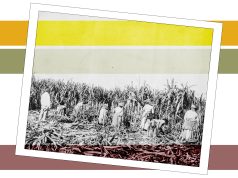
Imagine you’re throwing a Juneteenth party. You invite your friends and neighbors . . . and in through the door walks the Bible. As you welcome your guests and celebrate with them, you look over at the Bible, wondering what it’s doing. Your chest tightens as you nervously rehearse what it might say to someone. “Hey! Yeah, I know the host. I got invited, but I’m not really into Juneteenth myself. Did you know that slaves should obey their masters?”
Some of us are embarrassed by the Bible’s difficult passages on slavery. We wish it simply said, “Earthly masters, free your slaves. Slaves, leave your earthly masters,” and we can’t help but feel more antislavery than the Bible. So we push it aside to celebrate Juneteenth—ignoring the passages that confuse us, or pitting Jesus against Paul as if his household codes departed from his Lord.
Despite our doubts, the Bible belongs at the Juneteenth party. As we celebrate Juneteenth, we’re invited to see that the Bible’s new-creation abolitionism is more radical than you might think.
Abolishing More than Slavery
God doesn’t want to abolish only slavery but also the whole world order in which slavery exists—stripping the world down to the studs, eradicating oppressive human powers, and restructuring the cosmos to its core. This is the Bible’s abolition strategy, and it’s underway here and now through Jesus’s life, death, resurrection, and ascension. This program is the new creation.
God doesn’t want to abolish only slavery but also the whole world order in which slavery exists.
The reality of the new creation breaking into the present age is the key to understanding the Bible’s posture toward slavery. Slavery is part of the present evil age (Gal. 1:4), but through Christ, the eternal future—called the new creation—has broken into the present evil age, like light shining through a crack into a dark room. The new creation is referenced in many ways in the Bible but is most vividly seen in Revelation 21:1–4. Fundamentally, it shows up where the reign of God manifests itself, and under such a reign there will be no slavery.
Juneteenth helps us grasp the cosmic significance of the new creation. It celebrates another government’s joyful proclamation of a new order under a victorious ruler who erodes the old order and ushers in the new. Jesus is that ruler, the new creation the new order, the gospel the proclamation. The story of the Bible isn’t contrary to Juneteenth—it’s an echo.
Present Giving Way to the Future
Those who’ve accepted the proclamation of Jesus’s cosmic reign live with one foot in this age and one foot in the next. Here’s the good news: The future age is being ushered in while the present age passes away, and in light of this reality, the Bible forms its abolitionist ethic.
This new-creation abolitionism is reflected in the apostle Paul’s words in 1 Corinthians 7 to enslaved church members in Corinth. He tells them that “the appointed time has grown very short” (v. 29) for when the new creation will be fully manifest. He also tells them that at the same time “the present form of this world is passing away” (v. 31). The passing away of the present world and the coming of the new creation are so palpable that the enslaved in Christ are standing with one foot in enslavement and one foot in freedom. The difficult New Testament passages on slavery become accessible when we see this framework.
Engaging Slavery at the Border of the Ages
New-creation abolitionism explains the advice Paul gives to the enslaved in Corinth. To those who can’t attain their freedom, he tells them not to be concerned (v. 21). To those who can get their freedom, he tells them to get it. Why? The reasoning for both sets of commands is one and the same. The enslaved Christian is a “freedman of the Lord” (v. 22).
What does this mean? With the coming of the new creation, enslavement is passing away and is the least true thing about them, even if they’re currently trapped within the social structure of Greco-Roman slavery. On the other hand, he gives advice to the free people: They’re forbidden to become slaves. Why? They “were bought with a price” by Jesus and, thus, shouldn’t be property of another man (v. 23).
The previous point is important to highlight: Slavery isn’t just a neutral institution that suffered abuses; it’s contrary to the gospel. The reality of the new creation forbids entering slavery, commands people to work toward freedom, and lifts those stuck in it.
Do you see what’s happening? Their new-creation status reshapes how they see themselves and how they relate to others. The dawn of the new creation is the dusk of slavery.
The straddling of two ages also explains Paul’s letter to Philemon, a slave master, about his runaway slave, Onesimus. Under the “present evil age” and Roman law, Onesimus is property belonging to Philemon; in the new creation, the two are brothers, with Paul as their spiritual father.
The whole letter is Paul persuading Philemon to relate to Onesimus according to the new creation rather than the present age—a monumental shift (Philem. 1:16–17). Even if Onesimus wasn’t freed by Roman law, he was freed by divine law. It would have been easy for Paul to simply command the release (which he pastorally does), but that alone would miss the chance to recruit Philemon to the Bible’s new-creation abolitionism. Paul wanted Philemon’s heart, not merely his hands—this is a whole letter dedicated to the gutting of slavery.
As we officially start summer, I think of cicadas and their shed exoskeletons clinging to a tree on a warm summer day. Has a cicada been there? Yes. Does the structure look like a cicada? Yes. Is it a cicada? No. It’s a shell of its former self. The same goes for slavery among the church in the first century. Was it there? Yes. Did what remained look like slavery? Yes. Was it slavery? No, not really.
This new-creation reality makes sense of Ephesians 6:5–9 and Colossians 3:22–4:1. The social structure of slavery is hit by the meteor of Christ’s lordship: Both earthly slave and earthly master share one master, Christ, so the goal of their lives within that structure is its deeper passing away and the new-creation way of being.
Preserving the Social Structure?
Though Paul forbids free Christians to become slaves and commands enslaved Christians to work toward freedom, it might bother us on Juneteenth that Paul tells the enslaved who cannot get their freedom, “Do not be concerned,” and still tells them to obey. It might bother us that Peter tells servants to be subject to unjust masters as a way of practicing subversive goodness after the pattern of Christ (1 Pet. 2:18). It also might bother us that Paul tells masters to treat the enslaved justly instead of commanding them to be freed (Col. 4:1). What do we do with these statements?
In short, the biblical authors really did believe that “the present form of this world is passing away” (1 Cor. 7:31). Slavery really was on its way out. Like an ocean washing away a sandcastle wave by wave, God’s active judgment against this world was intensifying in synchronization with the in-breaking of the new creation. It’s this intensification that Paul refers to when he tells the Corinthians of “the present distress” (v. 26).
The social structure of slavery is hit by the meteor of Christ’s lordship.
God’s judgment has long purged and destroyed unjust societies through cataclysm as a pattern of world history—ask Abraham about Sodom and Gomorrah (Ezek. 16:49) and Isaiah about the nations (Isa. 13–25). Jesus’s reign intensified this pattern as a necessary precursor to the new creation (Rev. 5–6): ask Jesus about Jerusalem (Matt. 23; Mark 13:1–23), John about Rome (Rev. 18), and the black church about American chattel slavery and Jim Crow terror.
In these Bible passages, what’s at work is an ethic of hopeful, subversive, Christ-centered survival in a society where slavery was entrenched. Can’t get your freedom under an unjust master? Saturate that home with Christ’s goodness and righteousness. Need your enslaved workers to stay in your household for their livelihood? Treat them with Christ’s justice and equity, in protest against Roman law’s teaching that they have no rights as property.
The goal was to pump the antigospel institution of slavery so full of Christ until it burst, to survive as they awaited God’s judgment, temporally and eternally. It’s this divine judgment of slavery that we celebrate on Juneteenth.
New Creation’s Active Calling
This brand of abolitionism can sound like pretend, make-believe freedom in a world where slavery crushed the real bodies of image-bearers, as though the theology makes us passive. Quite the contrary: The new creation is enacted in how we live. Christians actively fight slavery and pursue the community of love that the new creation calls us to.
Christian, as we join the Juneteenth celebrations, let’s be reminded of our own abolitionist framework, a framework that allows you to truly show up, proud of the Bible and its gutting of slavery.