When timelines and details matter
by Alexsys Thompson, for Following the Yellow Brick Road
On May 20, 2026, the Democratic Speaker of the Vermont House and the Republican House Minority Leader issued a rare joint statement describing what they called “hateful, threatening rhetoric” in the debate over Act 181. The statement named Representative Amy Sheldon, chair of the House Environment Committee, as the target of “personal, threatening attacks.”
Public records obtained by Vermont Investigative through the Vermont Public Records Act document what preceded that statement, what accompanied it, and what law enforcement found — before and after it published.
The dates matter. Here is what the record shows.

The timeline
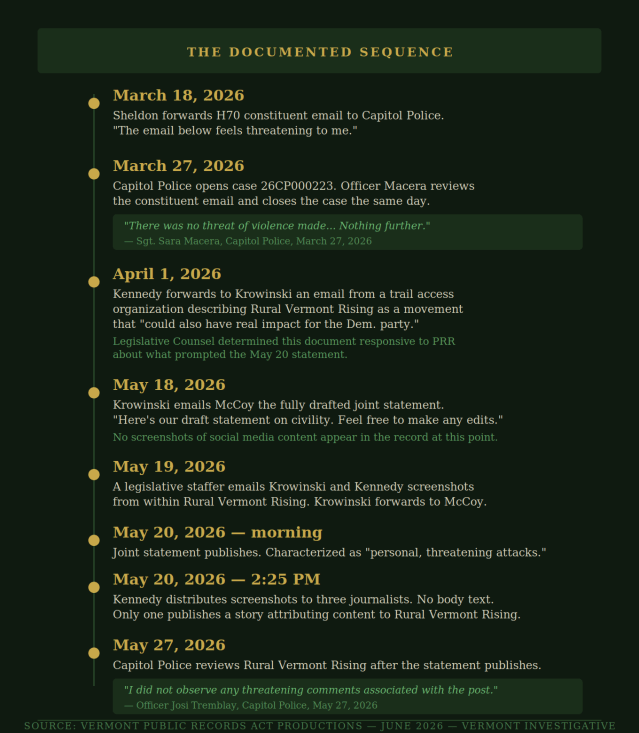
March 18, 2026. Representative Amy Sheldon forwarded a constituent email to Capitol Police Chief John Poleway with the note: “The email below feels threatening to me.” The email was about House bill H70 — Sheldon’s conservation legislation. The sender expressed anger about Act 181 and what they described as government overreach, and stated their intention to “fight back, not by protesting and then blaming police when our feelings are hurt, but in person at your committee meetings in a very loud and upfront way.”
March 27, 2026. Capitol Police Chief Poleway forwarded the email to Sergeant Sara Macera and asked her to open a case. Case 26CP000223 was opened the same morning. Macera reviewed the constituent email — the one describing the intent to show up at committee meetings — and documented her finding the same day: “There was no threat of violence made, and coming to the State House to committee meetings is not a law violation. Nothing further.” The case was cleared at 10:44 AM.

April 1, 2026. Conor Kennedy, Chief of Staff to Speaker Jill Krowinski, forwarded to Krowinski an email from a redacted sender writing on behalf of a trail access organization. The sender described a specific concern: that the Vermont Act 181 Facebook page’s organizing around Act 181 opposition was leading private landowners to pull public trail access from their properties.
The email described the group as a movement that “could also have real impact for the Dem. party” and asked the Speaker’s office for “leadership on slowing down this process.”
This is the earliest documented communication in Krowinski’s office about the group, dated seven weeks before the civility statement was issued.
May 18, 2026. Krowinski emailed House Minority Leader Pattie McCoy with the subject line “Draft Statement.” The message read: “Here’s our draft statement on civility. Feel free to make any edits.” The full text of what would become the joint statement was attached. It was drafted in the Speaker’s office and sent to the Minority Leader for review two days before it published.
No screenshots of social media content appear in the record at this point.
May 19, 2026. The day after the draft was in McCoy’s hands, a legislative staffer emailed Krowinski and Kennedy with the subject line “Comments on AS.” Attached were screenshots of comment threads from within the Rural Vermont Rising Facebook group — specifically from a post by a group member. That same evening, Krowinski forwarded the screenshots to McCoy.
May 20, 2026, morning. The joint statement published. It described “social media and email messages targeting Representative Amy Sheldon that are truly reprehensible” and characterized them as “personal, threatening attacks.”
May 20, 2026, 2:25–2:26 PM. Kennedy emailed the same screenshots to three journalists: Shaun Robinson of VTDigger, Kevin McCallum of Seven Days, and Paul Heintz of the Boston Globe. The subject line was “181 Screenshots.” The emails contained no body text — only the attachments.
Of the three, only Heintz published a dedicated story on the screenshots. That story reported that according to Kennedy, each of the comments originated with Rural Vermont Rising.
May 27, 2026. Six days after the statement published, Capitol Police Officer Josi Tremblay documented that a representative approached her asking whether she was aware of threats involving individuals posting addresses and photographs of representatives’ homes. Tremblay contacted Macera, who said she had not heard of any related incidents.
Tremblay then spoke with Kennedy. Kennedy told her that Sheldon had an aerial photograph of her property posted on Rural Vermont Rising. Tremblay reviewed the page and a post. Her documented finding: “I did not observe any threatening comments associated with the post.”
No new case number was opened. No referral to Vermont State Police or any other law enforcement agency appears in any record produced.
Vermont State Police confirmed separately that they have no incident reports, complaint logs, or referral communications related to threats against Representative Sheldon.
What the sequence shows
The draft statement was written before the screenshots were compiled. The screenshots arrived internally the day after the draft was already in the Minority Leader’s hands. Law enforcement reviewed the content that generated the case — and found no threat. Law enforcement reviewed Rural Vermont Rising after the statement published — and found no threatening comments.
The question the record raises is not whether the comments in the screenshots were offensive — many of them plainly were. The question is what the documentary record shows about the sequence of events, and how that sequence compares to what was said publicly.
The records document that sequence. Readers can weigh what it shows.
A note on Rural Vermont Rising
Colleen Geddis, administrator of Rural Vermont Rising, issued a public statement in May 2026 documenting three claims: that the allegations against the group moved goalposts over time, that law enforcement had not contacted group moderators, and that leadership had refused to share specific account details with moderators despite naming the group publicly.
Capitol Police records confirm no contact with Rural Vermont Rising moderators. Vermont State Police records confirm no records related to threats against Representative Sheldon.
The Facebook page was operating under the name “Vermont Act 181” during the legislative session. Group administrator Collie Gold announced the name change to Rural Vermont Rising publicly on May 17, 2026 — three days before the joint statement published. The post stated the group “kept this Facebook page as ‘Vermont Act 181’ to maintain focus during the active legislative session.”
Right of reply
Vermont Investigative contacted Speaker Krowinski, Representative McCoy, Conor Kennedy, and Representative Sheldon before publication. Responses received will be reflected in an update.
Disclosure: After completing the reporting in this piece, the author joined Rural Vermont Rising as a member in an organizing capacity, not a leadership role. This series documents what the public record shows. Readers across the political spectrum are invited to draw their own conclusions.
Sources
All findings are drawn from primary source documents obtained through Vermont Public Records Act requests: certified productions from the Office of Legislative Counsel on behalf of Speaker Krowinski (June 11, 2026), Representative McCoy (June 11, 2026), Representative Sheldon (June 16, 2026), and the Vermont Capitol Police Department (June 15, 2026); and a records closure from the Vermont State Police (May 29, 2026). The Boston Globe article referenced is publicly available at bostonglobe.com (Paul Heintz, May 20, 2026).
Data tells stories. Patterns show convergence. Curiosity validates both. If this series has been useful to you, consider subscribing or supporting it at https://ko-fi.com/alexsysthompson.
The post What the record shows: The May 20 Act 181 threats statement first appeared on Vermont Daily Chronicle.
The post What the record shows: The May 20 Act 181 threats statement appeared first on Vermont Daily Chronicle.